

The short answer: Tooth extraction cost depends mainly on whether the removal is simple or surgical, plus any sedation, bone graft, and your insurance. CareCredit's 2024 cost study puts the U.S. average at about $177 for a simple extraction and $363 for a surgical one. Most people feel back to normal within a few days, while the bone keeps healing for months.
Hearing that a tooth may need to come out can bring up a lot of questions at once. Does it have to go? Will it hurt? How long will recovery take? And what will the extraction cost?
Below, we answer each one in plain language. At Smile Design Modern Dentistry, general dentist Dr. Erfan Imeni recommends an extraction only after checking whether the tooth can be saved, and our page on tooth extraction in Durham explains how the procedure works in our office.
When Can a Tooth Not Be Saved?
A tooth usually can't be saved when infection, decay, or a break has left too little healthy tooth to repair, or when it's stuck where it can't come in properly. A filling, a crown, or a root canal can rescue many teeth that look beyond help, so keeping your natural tooth is almost always the first goal. Common reasons for removal include:
- Severe infection: when decay reaches the pulp, the center of the tooth with its nerves and blood vessels, infection can set in. If it can't be treated, removal stops it from spreading.
- Damage that can't be repaired: a tooth that is badly decayed or broken, especially below the gum line, may not have enough strong structure left to hold a crown.
- Crowding: sometimes a tooth is removed to make room before orthodontic treatment.
- Impacted teeth: most often wisdom teeth that are trapped under the gum or bone, which can cause pain, infection, or crowding.
Before any decision, Dr. Imeni examines the tooth and uses digital imaging to see what's happening below the gum. If a root canal or crown can keep the tooth, we'll tell you. Extraction is the last resort, not the first.

Is It Cheaper to Pull a Tooth or Save It?
Pulling a tooth usually costs less on the day, but not always over time. Most gaps eventually need an implant, a bridge, or a denture, and that replacement can cost more than saving the tooth would have. If a root canal and a crown can keep the tooth, compare both routes before you decide.
What Is the Difference Between a Simple and Surgical Extraction?
The difference is how easily the tooth can be reached. A tooth extraction is the removal of a whole tooth, roots included, from its socket in the jawbone, and there are two main ways to do it:
- Simple extraction: the tooth is fully visible above the gum. It is gently loosened and lifted out, and the appointment is usually short.
- Surgical extraction: the tooth is broken at the gum line, has curved roots, or is still partly covered by gum or bone. The gum is eased back, and the tooth is usually removed in sections. That sounds bigger, but it is gentler on the bone around the tooth than forcing it out whole.
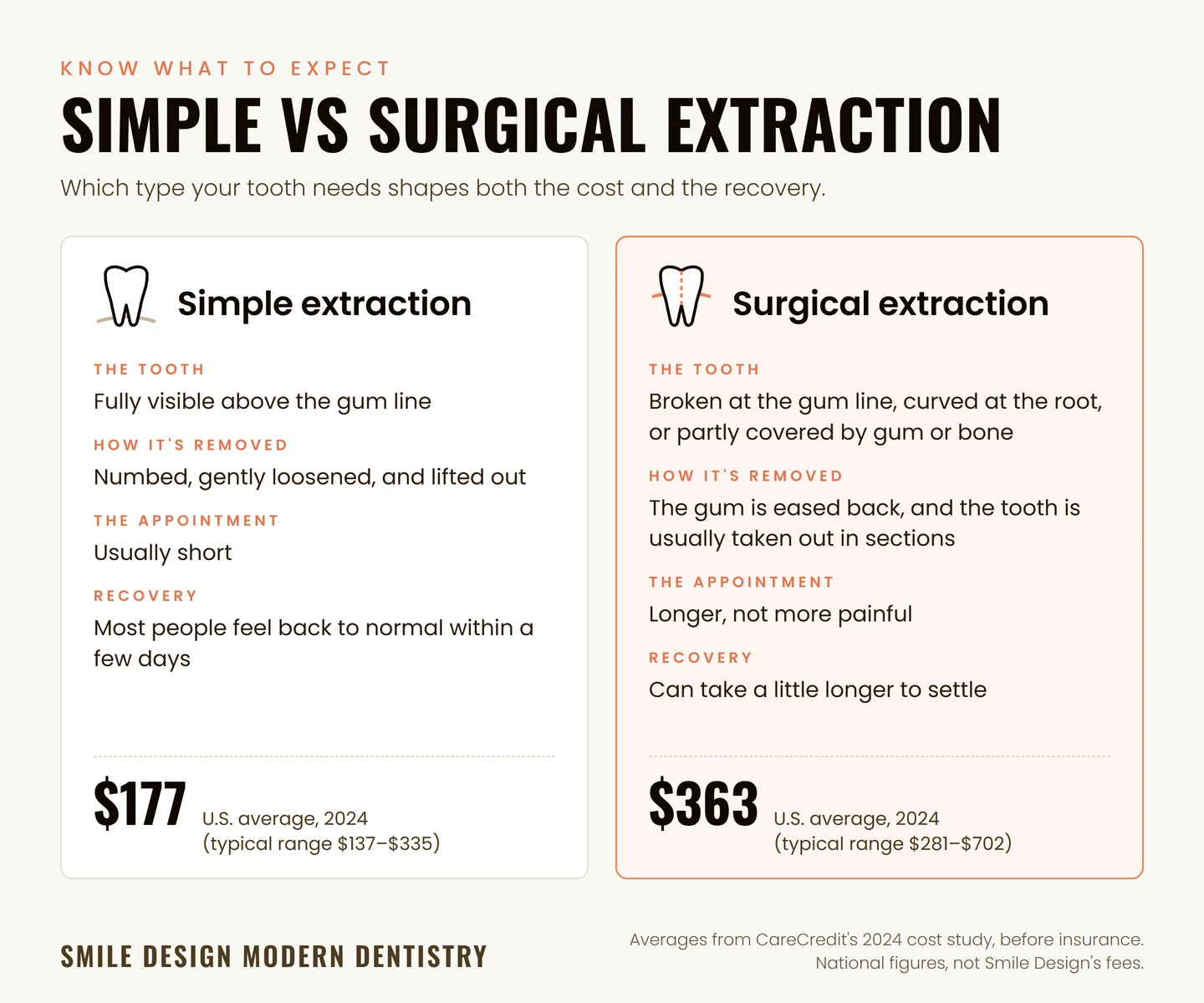
Front teeth usually have one root and often come out in one piece. Molars have two or three roots that can spread in different directions, so they may be removed root by root. That means a longer appointment, not a more painful one. Dr. Imeni will tell you which type your tooth needs before the appointment, since it affects both the fee and the recovery.
Wisdom teeth are the extractions patients ask about most. Our page on wisdom teeth removal explains how Dr. Imeni assesses them and when a deeply impacted tooth is referred to a specialist.
How Much Does a Tooth Extraction Cost?
There's no single price, because tooth extraction cost depends on the type of extraction, which tooth it is, and what else your treatment includes. For a sense of typical prices, CareCredit's tooth extraction cost guide (September 2024) reports these national figures from its 2024 cost study. They are typical U.S. ranges before insurance, not Smile Design's fees:
| Type of extraction | Typical U.S. range | U.S. average |
|---|---|---|
| Simple extraction | $137 to $335 | $177 |
| Surgical extraction | $281 to $702 | $363 |
| Impacted tooth, partly covered by gum | $325 to $829 | $423 |
| Impacted tooth, fully in the bone | $413 to $1,041 | $532 |
In the same study, the average simple extraction in North Carolina was $161.
What Affects the Price of an Extraction?
- Which tooth it is: a single-root front tooth is usually simpler than a molar with several roots.
- Simple or surgical: a surgical extraction takes more time and care.
- Sedation: nitrous oxide or oral sedation becomes part of your plan if you choose it.
- Bone grafting: if you plan an implant later, a small graft at the same visit may be recommended.
Does Insurance Cover a Tooth Extraction?
Usually, in part. An extraction is usually medically necessary rather than cosmetic, so dental insurance often covers some of the cost, depending on your deductible, coverage level, and annual maximum. Smile Design is in-network with major insurance providers, and financing is available through Cherry, CareCredit, and other lenders. Most importantly, you'll get an estimate before treatment begins, so there are no surprises.
Not sure whether your tooth can be saved, or what your extraction would involve? See how tooth extractions work at Smile Design.
What Happens on the Day of a Tooth Extraction?
Most tooth removal appointments follow the same five steps:
- Exam and imaging: Dr. Imeni reviews your images to plan the safest, gentlest approach.
- Numbing: the area is numbed with local anesthetic, so you feel pressure rather than pain.
- Sedation if you'd like it: for anxious patients, sedation dentistry options include nitrous oxide, which wears off within minutes, and oral sedation, which leaves most people relaxed and remembering little. With oral sedation, you'll need someone to drive you to and from your appointment.
- Removal: the tooth is gently loosened and removed, protecting the tissue around it.
- Aftercare: you'll leave with written instructions and know exactly when to call us.
How Long Does It Take to Recover From a Tooth Extraction?
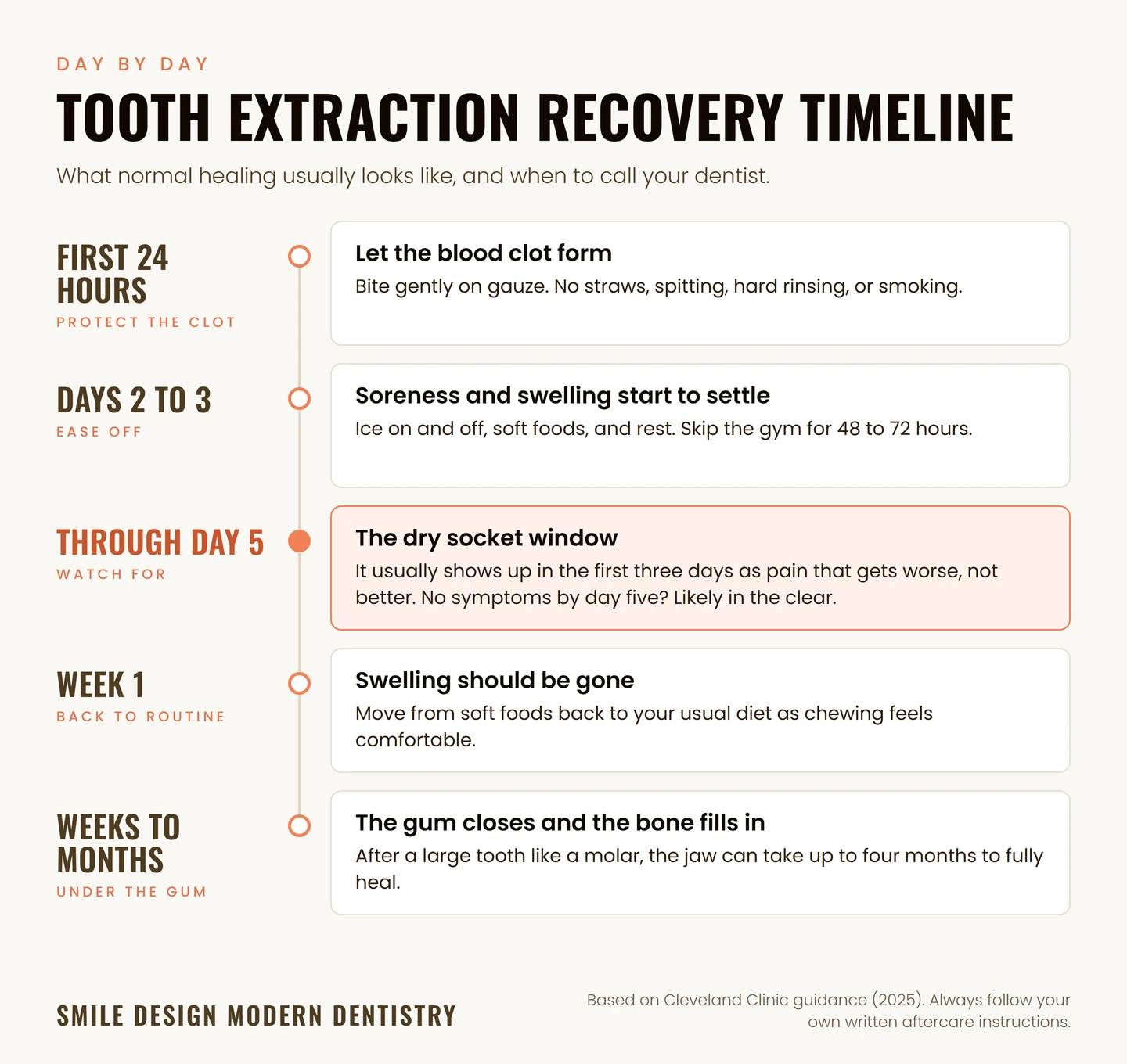
Most people feel back to normal within a few days and can return to routine activities within 48 to 72 hours, according to Cleveland Clinic. The bone underneath takes longer: after a large tooth like a molar, the jaw can take up to four months to heal fully.
First 24 Hours: Protect the Blood Clot
A blood clot forms in the socket and shields the bone and nerves while you heal, so protecting it is your main job.
- Bite gently on gauze until the bleeding slows. A little oozing the first night is normal.
- Don't drink through a straw, spit forcefully, or rinse hard.
- Don't smoke or vape, which slows healing.
- Rest, and skip the gym for the first 48 to 72 hours.
Days Two and Three: Soreness Starts to Settle
Some soreness and swelling are normal and usually ease over the next few days. An ice pack on your cheek, 20 minutes on and 20 minutes off, can help, and over-the-counter pain relief usually manages the discomfort. Keep brushing the rest of your mouth gently.
What Can You Eat After a Tooth Extraction?
Start with soft foods, such as yogurt, applesauce, eggs, pasta, or rice, and cool or lukewarm drinks. Avoid very hot, fizzy, hard, or crunchy food while the socket is tender, and chew on the other side. Most people return to their usual diet over the first week as chewing feels comfortable.
The Weeks After: The Gum and Bone Heal
Swelling should be gone within about a week. The gum closes over the socket during the following weeks, and the bone fills in from the bottom up over the next few months. If a wisdom tooth was removed, our wisdom teeth recovery guide sets out the timeline in more detail.
What Is Dry Socket, and How Can You Tell?
Dry socket is a painful complication that happens when the blood clot in the socket comes loose or doesn't form properly, leaving the bone underneath exposed. Cleveland Clinic notes that it affects about 2% to 5% of tooth extractions, is more common after wisdom teeth removal, and usually develops within the first three days. If you have no symptoms by day five, you're likely in the clear.
Dry Socket vs Normal Healing
- Normal healing: the socket holds a dark clot that looks like a scab, and the soreness eases a little each day.
- Dry socket: the socket looks like an empty hole, sometimes with whitish bone at the bottom, and a deep, throbbing ache gets worse instead of better. The pain can spread from the jaw toward the head and neck, often with a bad taste or bad breath.
Pale tissue can also be part of normal healing, so color alone isn't a reliable sign. The clearer clue is pain that builds after the first few days instead of fading.
How Is Dry Socket Treated and Prevented?
Dry socket is treatable. As the ADA's MouthHealthy guide to dry socket explains, your dentist cleans the socket and places a medicated dressing, changed until the pain eases. Call us instead of waiting it out.
To lower your risk, don't smoke or use tobacco while you heal, since smokers are more than three times as likely to develop dry socket. Avoid straws, and skip warm and fizzy drinks while you heal. If you take birth control pills with estrogen, mention it before your extraction, because they can slow healing.
When Should You Call Us?
Get in touch if bleeding hasn't slowed after several hours, if swelling is still growing after the third day, if pain is getting worse instead of better, if you see pus around the site, or if you develop a fever of 100.4°F or higher.
Should You Replace a Tooth After an Extraction?
Usually, yes, unless the tooth was removed for crowding or was a wisdom tooth. When a gap is left, nearby teeth can drift, and the bone that held the tooth slowly shrinks. Most of that bone change happens in the first few months.
Replacement options include dental implants, bridges, and dentures. If an implant is likely, a small bone graft placed in the socket on the day of the extraction, called socket preservation, helps keep the ridge in good shape. It's far easier to hold onto bone than to rebuild it later, so it's worth planning before the extraction. Dr. Imeni has placed more than 1,000 dental implants and plans implant cases with CBCT 3D imaging. Our guide to dental implant cost in Durham explains what extraction, socket preservation, and grafting each involve.
Planning a Tooth Extraction at Smile Design
If a tooth is hurting, broken, or you've been told it may need to come out, an exam will show you exactly where you stand, including whether it can be saved. Our tooth extraction page covers the procedure, sedation, and aftercare in our office.
We see patients from Durham, Chapel Hill, Raleigh, Cary, Morrisville, and across the Triangle. Call Smile Design Modern Dentistry at (919) 220-5505 or visit us at 5318 NC-55, Suite 101, Durham, NC 27713 to book your visit.
Frequently Asked Questions
How much does a tooth extraction cost?
It depends on the tooth and the type of extraction. CareCredit's 2024 cost study puts the U.S. average at about $177 for a simple extraction and $363 for a surgical one, before insurance. At Smile Design, you get an estimate before treatment begins.
Does a tooth extraction hurt?
The area is numbed first, so most people feel pressure rather than pain. Sedation is available if you feel anxious, and some soreness for a few days afterward is normal.
How long does it take to recover from a tooth extraction?
Most people feel back to normal within a few days. The gum closes over the following weeks, and after a large tooth like a molar, the jaw can take up to four months to heal fully.
What does dry socket feel like?
A deep, throbbing ache that gets worse instead of better, usually starting within the first three days. The pain can spread from the jaw toward the head and neck, often with a bad taste or bad breath.
When can I eat solid food after an extraction?
Start with soft foods and cool or lukewarm drinks, then return to your usual diet over the first week as chewing feels comfortable. Chew on the other side, and skip hard or crunchy food until the area is less tender.
Can a tooth be saved instead of pulled?
Often, yes. A filling, crown, or root canal can save many damaged teeth, and Dr. Imeni checks whether your tooth can be kept before recommending an extraction.
Do I need to replace a pulled tooth?
Usually, yes, unless it was removed for crowding or was a wisdom tooth. Replacing it helps stop nearby teeth from shifting and protects the bone, and options include implants, bridges, and dentures.